
Industry updates and market insights on global used car trade, buyer demand, and cross-border export opportunities.
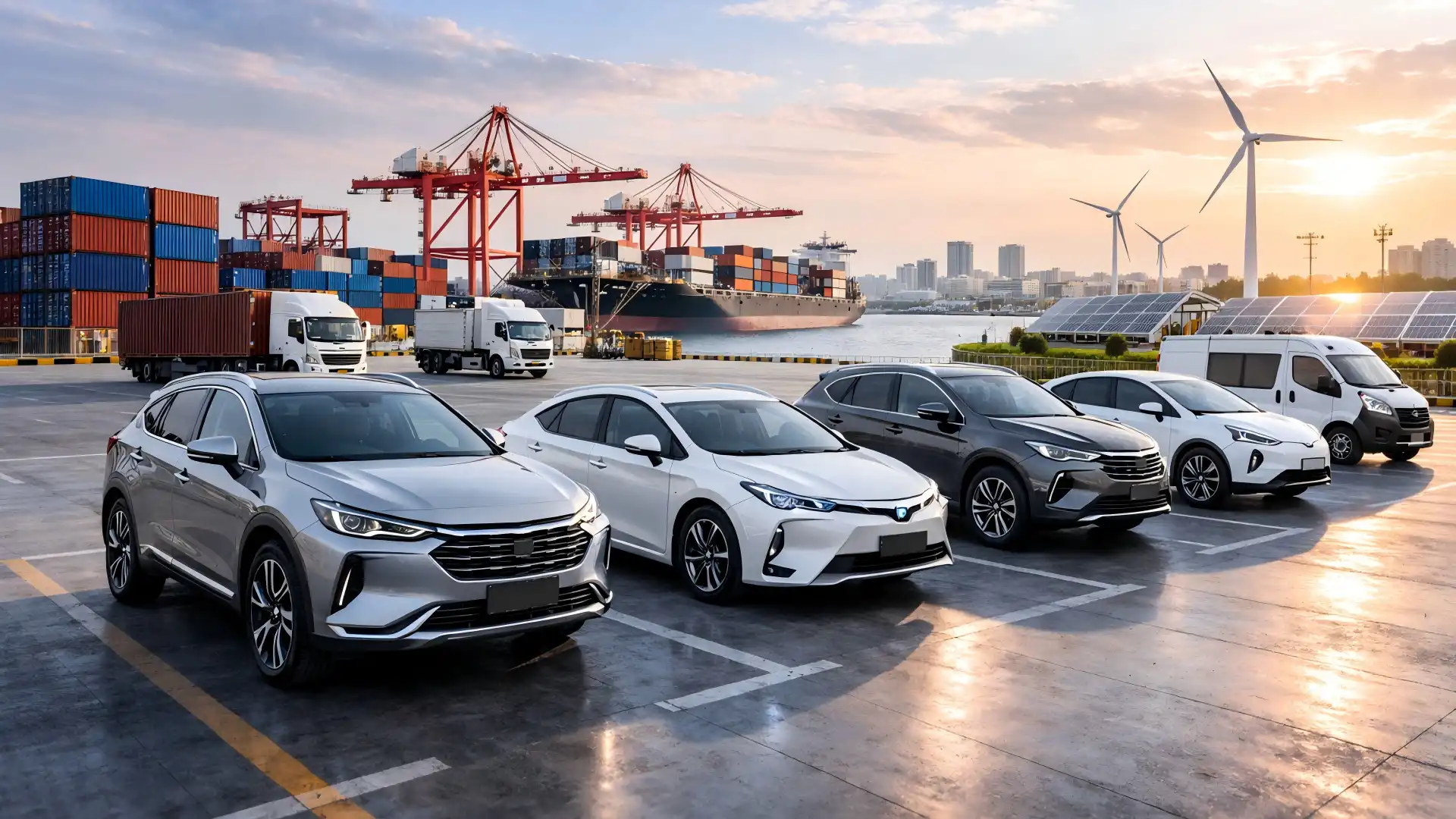
The 2026 Landscape of Global B2B Vehicle Procurement
Policy-Driven EV Expansion vs. Commercial Reality
In 2026, Global B2B Vehicle Procurement remains strongly influenced by government-led electrification policies. Incentives and emissions targets continue to push full EV adoption in developed markets.
However, enterprise buyers operate under stricter commercial constraints. Procurement decisions must balance regulatory compliance with operational reliability, cost stability, and long-term asset performance. The gap between policy ambition and practical deployment is increasingly visible outside major urban centers.
Enterprise Fleet Priorities in a Cost-Sensitive Market
Fleet managers prioritize lifecycle cost, uptime reliability, and resale flexibility. Unlike consumer buyers, enterprises treat vehicles as operational assets.
Battery degradation concerns, energy price volatility, and uncertain secondary-market value introduce financial risk. As a result, Global B2B Vehicle Procurement strategies are increasingly shaped by risk management rather than rapid electrification alone.
Structural Constraints of Full EV Adoption in B2B Markets
Infrastructure and Operational Limitations
Charging infrastructure continues expanding, yet remains inconsistent across emerging markets and cross-border trade routes. For logistics operators and exporters, infrastructure uncertainty translates directly into operational risk.
Long-haul routes and remote applications often demand refueling flexibility that full EV platforms cannot always guarantee.
Total Cost of Ownership and Residual Value Risk
Although EV operating costs can be lower under ideal conditions, upfront acquisition costs and battery replacement concerns remain key barriers.
Residual value volatility in secondary markets further complicates fleet planning. For export-oriented buyers, asset liquidity remains critical, and EV depreciation patterns are still evolving.
Why Hybrids Are Gaining Strategic Momentum
Lower Transition Risk for Enterprise Buyers
Hybrid vehicles combine combustion reliability with electrification benefits, reducing dependence on charging networks while improving fuel efficiency.
For Global B2B Vehicle Procurement decision-makers, hybrids represent a lower-risk transition strategy. They allow gradual emission reduction without full infrastructure exposure.
Greater Market Compatibility Across Regions
Procurement strategy in 2026 is highly regionalized. Markets in the Middle East, Central Asia, Africa, and parts of Latin America continue to prioritize infrastructure resilience and maintenance simplicity.
Hybrids offer stronger cross-market adaptability, improving fleet flexibility and resale potential across diverse regulatory environments.
Regional Divergence in Procurement Strategy
While parts of Western Europe and select urban markets accelerate full EV deployment, global procurement trends are not uniform.
Global B2B Vehicle Procurement increasingly reflects a layered approach: full EVs in infrastructure-ready regions, hybrids as a stabilizing bridge elsewhere. Technology preference is now closely tied to regional readiness.
Strategic Outlook for 2026–2030
Enterprise electrification will likely progress in phases rather than through abrupt transitions. Full EV adoption will expand where infrastructure and policy alignment are strong.
In many global trade corridors, however, hybrids are positioned to remain a strategic alternative. For exporters and fleet operators, procurement decisions in 2026 are defined by operational pragmatism and risk-adjusted planning.