
Industry updates and market insights on global used car trade, buyer demand, and cross-border export opportunities.
Key Takeaways
- The Search Generative Experience (SGE) has replaced static keyword matching with conversational AI intent, requiring B2B auto importers to entirely pivot their digital visibility strategies.
- To feed AI algorithms effectively, auto platforms must build E-E-A-T (Expertise, Authoritativeness, Trustworthiness) by publishing verifiable technical data, SOH certificates, and advanced schema markup.
- Future-proofing your supply chain means partnering with a digitally transparent exporter like Hanhai U-CAR, ensuring your procurement data is readily recognized by both AI engines and enterprise buyers.
1. The Shift to SGE: Why Traditional Keywords Are Failing Vehicle Importers
The traditional playbook for B2B automotive sourcing is undergoing its most radical transformation in a decade. For years, driving traffic to an import-export website relied on a predictable formula: ranking for high-volume phrases like "Chinese used car exporter" or "buy electric trucks from China." However, as search engines transition into fully AI-driven response engines, those static keywords are losing their conversion power.
1.1 Understanding Google's SGE in 2026 Auto Sourcing
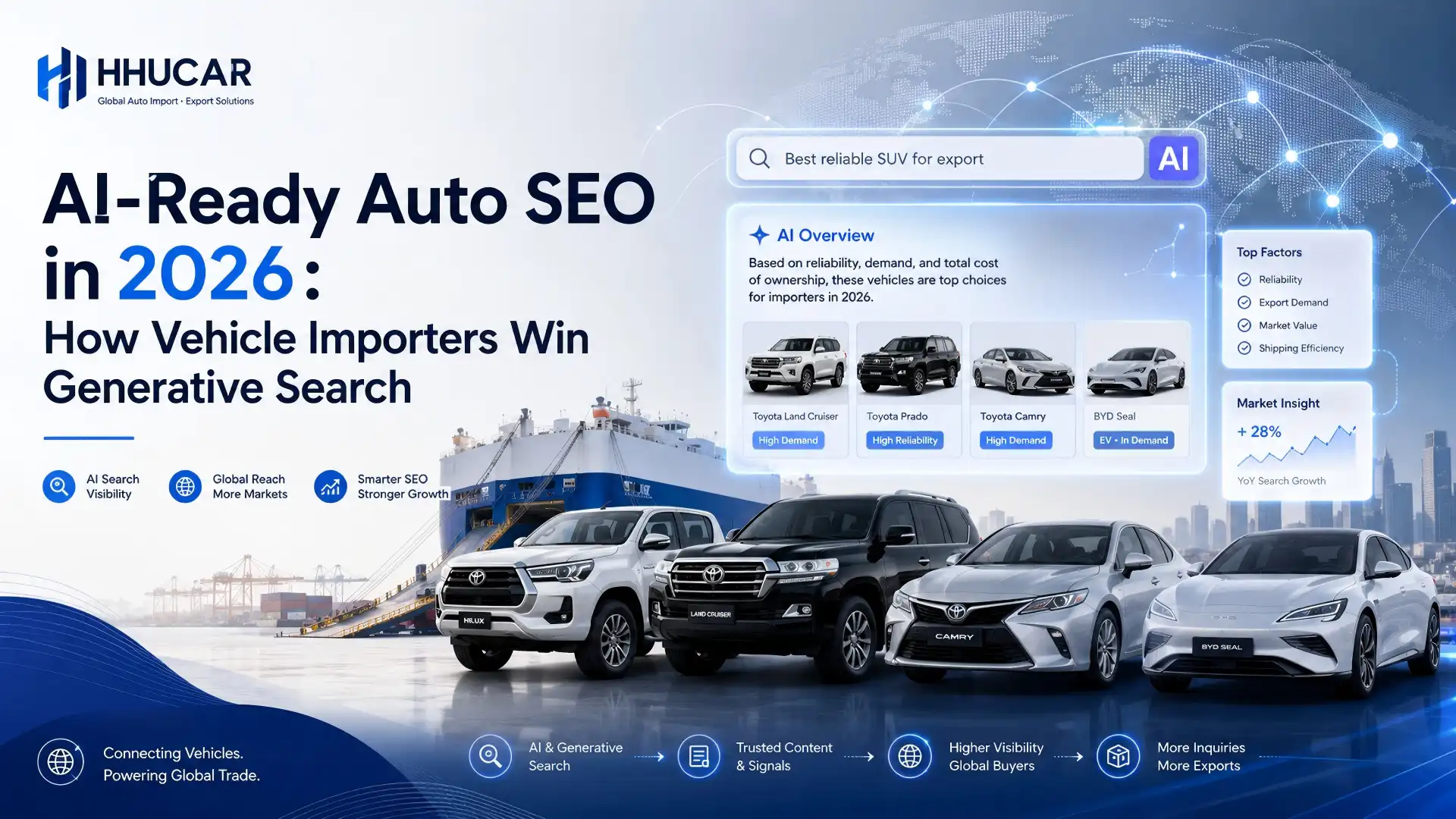
In 2026, the Search Generative Experience (SGE) has changed how global vehicle buyers research supply chains. Instead of clicking through a list of ten blue links, B2B procurement managers now receive a single, comprehensive, AI-synthesized answer at the very top of their search results. If your platform isn’t structured to feed these AI algorithms, your inventory becomes virtually invisible to international wholesale buyers.
1.2 Shifting from Exact Keyword Matches to Conversational AI Intent
AI search models do not scan pages for raw keyword repetition; they analyze the contextual depth of your content. Modern automotive buyers are typing complex, conversational strings into search boxes, such as: "Which Chinese EV brands have the best battery State of Health certificates for import into the Middle East?" Securing visibility requires a complete pivot toward semantic relevance and structured data.
2. Core Pillars of AI-Ready Auto SEO for B2B Importers
To adapt to this paradigm shift, your digital architecture must evolve. Implementing an effective AI-Ready Auto SEO strategy means treating search engines not just as indexes, but as advanced B2B buyers seeking verifiable technical proof.
2.1 Building E-E-A-T with Technical Data and Compliance Certificates
Google’s AI prioritize sources that display high levels of Experience, Expertise, Authoritativeness, and Trustworthiness (E-E-A-T). For vehicle importers, this means your website cannot just display aesthetic car photos. It must host deep, authoritative documentation regarding international export compliance, regional customs clearances, and technical specifications like Euro 7 emissions standards or battery degradation profiles.
2.2 Optimizing Long-Tail Queries for Complex Vehicle Sourcing Problems
Because AI search answers excel at resolving multifaceted problems, your content must directly target long-tail, high-intent B2B queries. Designing your site architecture around AI-Ready Auto SEO requires publishing dedicated landing pages and articles that answer granular logistical, financial, and regulatory questions that traditional content strategies usually overlook.
3. Actionable Blueprint: Optimizing Your Sourcing Site for AI Discovery
Transitioning your website into an AI-friendly platform requires both structural hygiene and targeted content creation. Here is how global auto traders can optimize their web footprint for AI scrapers.
3.1 Structuring Vehicle Inventory and Specifications for AI Scrapers
AI models rely heavily on clean data ingestion. To ensure your vehicle listings are pulled into AI-generated product comparison tables, you must implement advanced technical schema markup. Every vehicle listing on your site should clearly define parameters—such as mileage, battery capacity, year of manufacture, and model variants—in standardized, machine-readable code.
3.2 Creating High-Value Content That Solves International Logistics Pain Points
B2B buyers turn to AI search to de-risk their international transactions. Your content strategy should focus heavily on solving real-world friction. By publishing highly detailed guides on regional regulatory limits, digital RMB escrow payments, or maritime shipping restrictions, you create the exact high-value semantic nodes that AI engines use to formulate their synthesized recommendations.
4. Future-Proofing Your Auto Supply Chain with Hanhai U-CAR
Dominating the generative search landscape requires more than just optimized text; it requires aligning with supply chain partners who understand the future of digital automotive trade.
4.1 Why Digital Transparency and Verified Data Win in the AI Search Era
As AI search filters out low-quality, unverified brokers, transparency has become the ultimate currency in international B2B auto sourcing. Platforms that provide transparent pricing, certified vehicle traceability, and comprehensive logistics updates naturally gain the upper hand in the algorithmic ecosystem.
4.2 Partnering with an AI-Optimized Chinese Vehicle Export Leader
At Hanhai U-CAR (hhucar.com), we have engineered our export infrastructure to match the speed of modern digital commerce. By maintaining rigorous quality standards, complete documentation traceability, and a robust "1+3" service model, we ensure that our global partners have access to the highly verifiable data that AI search platforms reward.
Partnering with Hanhai U-CAR means future-proofing your automotive procurement strategy—giving you the supply chain reliability and digital clarity needed to lead your market in the AI era.