
Industry updates and market insights on global used car trade, buyer demand, and cross-border export opportunities.
Key Takeaways
- Strict age caps and the mandatory transition to Euro 6 emission standards are rapidly reshaping vehicle import regulations across the GCC and Africa in 2026.
- Relying on outdated sourcing methods risks severe port rejections; importers must pivot to compliant, near-new Chinese EVs and Hybrids (PHEVs) to maintain high residual value.
- Mandatory compliance checks, including exact VIN manufacturing date verification, SOH certificates, and pre-shipment inspections, are non-negotiable for guaranteed customs clearance.
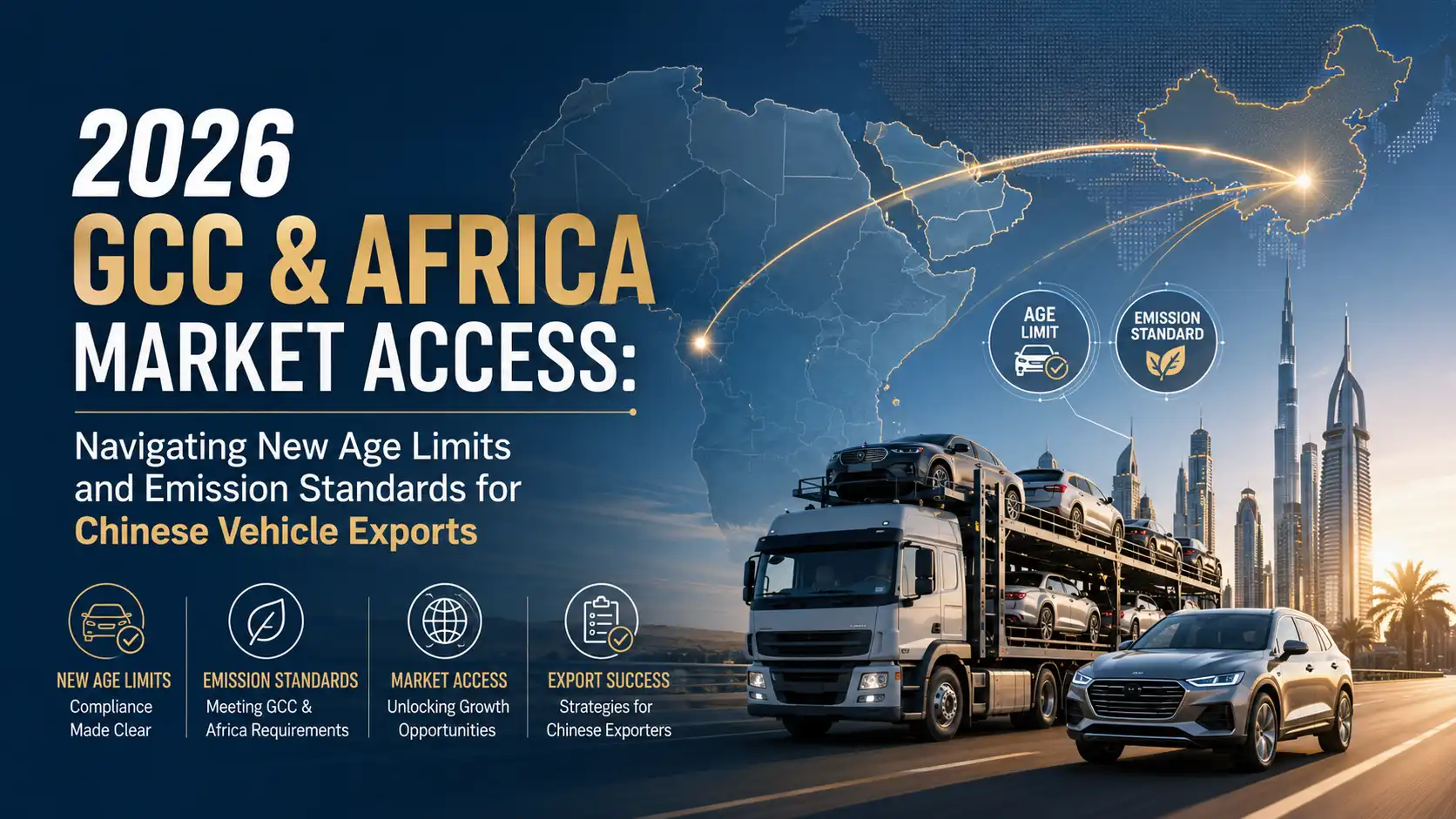
2026 GCC & Africa Market Access: Navigating New Age Limits and Emission Standards for Chinese Vehicle Exports.
As 2026 approaches, the global auto trade landscape is experiencing a massive regulatory shift. For international auto traders and fleet managers, securing seamless market access across the GCC and Africa is no longer just about competitive pricing—it requires strict regulatory compliance. With new vehicle age limits and tougher emission standards rolling out across major ports, understanding these rules is critical to protecting your supply chain and profit margins. In this comprehensive guide, Hanhai U-CAR breaks down exactly how these updated regulations impact Chinese vehicle exports, giving you the strategic insights needed to avoid costly customs rejections and future-proof your sourcing operations.
1. The 2026 Regulatory Shift: Redefining Market Access for Vehicle Imports
The era of unrestricted used car dumping is over. Governments across the Middle East and Africa are rapidly updating their national automotive policies to align with global carbon reduction goals and protect their emerging domestic auto industries.
For B2B buyers, this creates a dual-threat environment: strict age caps combined with elevated emission standards. Failing to understand these twin pillars of 2026 market access means facing delayed shipments, port rejections, or confiscation of inventory. Importers must pivot from buying the "cheapest available" to sourcing "compliant and high-quality" vehicles.
2. GCC Market Access Rules: Navigating Stricter Emissions and Age Caps
The Gulf Cooperation Council (GCC) remains a high-value destination for vehicle exports, but buyers here demand premium quality and immediate compliance.
2.1 Saudi Arabia (SASO) & UAE: The Push for Euro 6 and EV Transitions
Saudi Arabia’s SASO and the UAE’s ESMA are leading the charge. By 2026, we anticipate an accelerated phase-out of Euro 4 and Euro 5 vehicles in favor of Euro 6 compliance for internal combustion engines (ICE). For used car imports, the documentation requirements are tightening. Certificates of Conformity (CoC) and SABER registrations will strictly filter out vehicles that do not meet advanced emission targets.
2.2 How Age Limits Impact B2B Fleet Sourcing in the Middle East
For fleet buyers (such as ride-hailing or corporate leasing), age limits are the biggest hurdle. Countries like Saudi Arabia strictly enforce a maximum age limit (often 3 to 5 years depending on vehicle type) for passenger car imports. Consequently, sourcing 5-to-7-year-old used cars is no longer a viable B2B strategy. Buyers are now shifting toward "near-new" or zero-mileage parallel export vehicles from China to guarantee customs clearance and maintain high residual fleet value.
3. Decoding African Import Standards: Balancing Affordability with Compliance
Africa is a massive market, but it is not monolithic. Navigating market access here requires understanding distinct regional trading blocs.
3.1 East Africa (EAC): Tightening the Squeeze on Used Car Age Caps
The East African Community (EAC), led by Kenya, is aggressively reducing the age limit for imported vehicles. Historically allowing vehicles up to 8 years old, Kenya is moving steadily toward a 5-year or even 3-year age cap to reduce emissions and incentivize local assembly. Importers targeting Mombasa port must meticulously verify the manufacturing month and year to ensure compliance before loading the vessel.
3.2 West Africa (ECOWAS): Navigating Nigeria’s Changing Import Baselines
Nigeria remains a powerhouse for automotive imports. While historically more lenient than East Africa, recent customs reforms emphasize higher duties on older, high-emission vehicles. To maintain profitability in West Africa, importers must balance the age of the vehicle with the associated import levies, making cost-effective, newer models highly desirable.
Projected 2026 Import Compliance Overview (GCC & Africa)
| Region / Country | Anticipated Age Limits (Used Cars) | Emission Standard Focus | Import Documentation Priority |
|---|---|---|---|
| Saudi Arabia | 3 - 5 Years | Euro 6 / EV | SABER, SASO CoC |
| UAE | Strict monitoring on older vehicles | Euro 6 / EV | ESMA Certification |
| Kenya (EAC) | 5 Years (Trending stricter) | Euro 4 minimum (Trending Euro 5) | QISJ Pre-export inspection |
| Nigeria | 12-15 Years (Higher duties on older) | Euro 3/4 | Customs PAAR |
(Note: Regulatory environments are dynamic. Always consult with Hanhai U-CAR experts for real-time port updates before purchasing).
4. Turning Compliance into a Strategic Advantage with Chinese Vehicles
While tightening regulations challenge traditional sourcing models, they create a massive opportunity for buyers importing from China.
4.1 High-Quality ICE and Hybrids (PHEV): The Ultimate Bridging Solutions
Chinese domestic emission standards (China 6b) are among the strictest in the world, often exceeding Euro 6 requirements. This means late-model Chinese ICE vehicles and Plug-in Hybrid Electric Vehicles (PHEVs) inherently satisfy the 2026 emission standards of both the GCC and Africa. Brands like BYD, Geely, and Changan offer near-new, compliant vehicles at a fraction of the cost of their European or Japanese counterparts.
4.2 Standardized SOH Certificates & Export Traceability
When sourcing used EVs or Hybrids, battery degradation is a primary concern for customs. Top-tier Chinese exporters now provide standardized State of Health (SOH) certificates and complete vehicle traceability reports. This transparent documentation is exactly what destination ports require to grant smooth market access.
5. 4-Step Compliance Checklist for Guaranteed Customs Clearance
To protect your investments in 2026, follow this mandatory checklist before executing any overseas procurement:
- Verify the VIN and Manufacturing Date: Do not rely on registration dates. Calculate the vehicle's age strictly from the manufacturing month to ensure it falls within the destination port's age limit.
- Confirm Emission Equivalency: Ensure the vehicle's original emission standard (e.g., China 6) translates legally to the required local standard (e.g., Euro 6).
- Secure Pre-Shipment Inspections: Many African and GCC countries require third-party inspections (like QISJ or SGS) before the vehicle leaves the Chinese port.
- Partner with an Authorized Exporter: Work with suppliers who hold official export licenses and can provide the necessary export clearance, CoC, and battery health documentation.
6. Conclusion: Secure Your Auto Supply Chain with Hanhai U-CAR
Navigating the complexities of 2026 market access doesn't have to be a bottleneck for your business. By understanding the evolving age limits and emission standards across the GCC and Africa, you can strategically shift your sourcing toward high-quality, compliant Chinese vehicles.
At Hanhai U-CAR, we specialize in bridging the gap between China's vast auto inventory and global regulatory demands. Our expert team handles everything from vehicle sourcing and SOH certification to complex export logistics, ensuring your fleet arrives on time and fully compliant.